Aerospace Manufacturing Company: Leading Innovations in Aircraft Production
Discover how aerospace manufacturing is revolutionizing the future of flight through groundbreaking innovations and technological advancements. From commercial airliners to spacecraft, this industry shapes how we connect, travel, and explore the cosmos.
Overview of the Aerospace Manufacturing Industry
The aerospace manufacturing industry drives global technological advancement through the design, development, and production of aircraft, spacecraft, and related systems. These organizations create everything from commercial airliners to satellites, forming the foundation of modern aviation and space exploration. The industry encompasses the manufacturing of:
- Critical propulsion systems and engines
- Advanced avionics and navigation systems
- Specialized aerospace materials
- Complex structural components
- Safety and control systems
With global annual revenues exceeding hundreds of billions of dollars, aerospace manufacturing employs millions of highly skilled workers across engineering, production, and support roles. The complexity of modern aircraft, containing millions of precisely engineered parts, demands unparalleled manufacturing precision and quality control systems.
Key Players and Their Contributions
The global aerospace landscape features industry giants that consistently push the boundaries of aviation technology:
| Sector | Major Companies | Specialization |
|---|---|---|
| Commercial Aviation | Boeing, Airbus | Large commercial aircraft |
| Military/Defense | Lockheed Martin, Northrop Grumman, BAE Systems | Military aircraft, defense systems |
| Regional Aviation | Embraer, COMAC, Bombardier | Regional jets, business aircraft |
| Space Sector | SpaceX, Thales Alenia Space, Airbus Defence | Launch vehicles, satellites, spacecraft |
Significance in Global Transportation
Aerospace manufacturing underpins global transportation networks, facilitating the movement of over 4 billion passengers annually and more than one-third of global trade by value. The industry’s economic impact extends far beyond direct manufacturing, creating 3-4 additional positions throughout the economy for every aerospace job.
Innovations in Aircraft Production
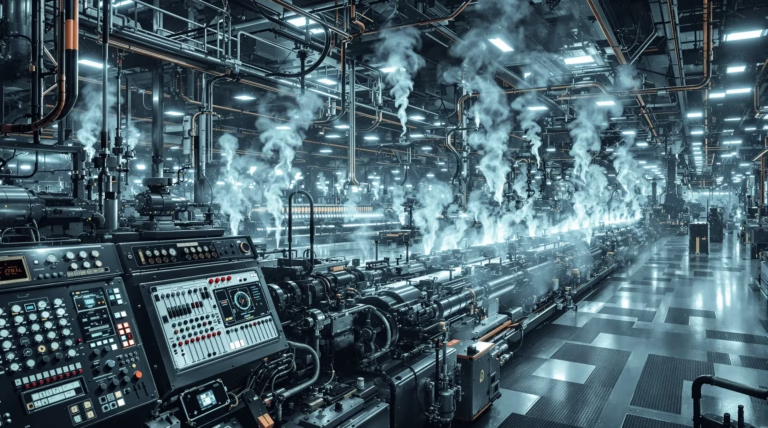
The aerospace sector is undergoing a technological revolution, implementing digital-first production strategies and smart factory solutions. These innovations include:
- IoT sensors for real-time monitoring
- Artificial intelligence systems for production optimization
- Digital twin technology for simulation and testing
- Advanced analytics for quality control
- Automated production systems
Additive Manufacturing and Automation
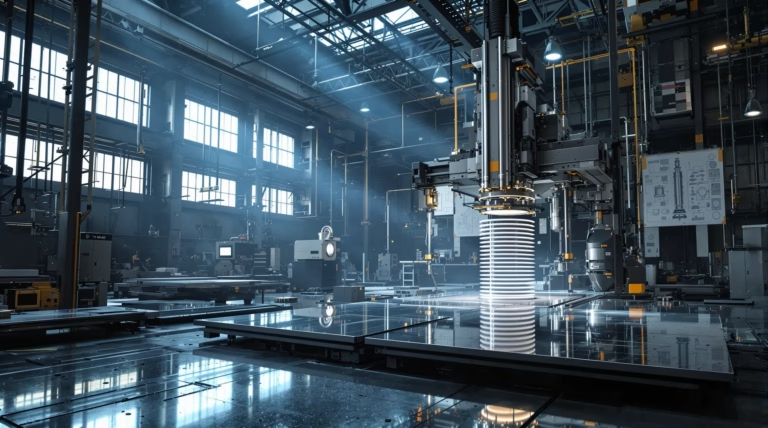
3D printing has transformed aerospace component production, enabling the creation of complex geometries previously impossible to manufacture. For example, GE Aviation’s 3D-printed fuel nozzle represents a breakthrough in design consolidation, reducing 20 separate parts into a single component while achieving:
- 25% weight reduction
- 5x increase in durability
- Simplified maintenance procedures
- Enhanced performance efficiency
- Reduced assembly time
Modern aerospace facilities utilize advanced automation systems, including robotic drilling systems and autonomous guided vehicles, increasing production rates by up to 40% while maintaining superior quality standards.
Role of Materials Science
Advancements in materials science have revolutionized aircraft design and manufacturing capabilities. Modern commercial aircraft like the Boeing 787 Dreamliner and Airbus A350 XWB utilize composite materials for over 50% of their airframes, particularly carbon fiber reinforced polymers (CFRPs). These innovations have delivered remarkable benefits:
- 20% weight reduction compared to traditional aluminum structures
- Significant improvements in fuel efficiency
- Extended operational range
- Enhanced structural integrity
- Reduced maintenance requirements
The manufacturing landscape has evolved to accommodate these advanced materials through specialized processes including automated fiber placement (AFP) and resin transfer molding (RTM). Beyond composites, the industry has embraced several cutting-edge materials:
| Material Type | Application | Benefits |
|---|---|---|
| Ceramic Matrix Composites | Engine components | High-temperature resistance |
| Advanced Aluminum Alloys | Structural elements | Enhanced strength-to-weight ratio |
| Nanomaterials | Specialized components | Unique performance properties |
| Bio-sourced Composites | Interior components | Improved sustainability |
Sustainable Practices in Aerospace Manufacturing
The aerospace industry is experiencing a transformative shift toward sustainability, combining environmental responsibility with competitive advantage. Manufacturers implementing comprehensive sustainable practices have achieved remarkable results:
- 30% reduction in waste production
- Significant decreases in carbon emissions
- 15% higher long-term financial performance
- Enhanced brand reputation
- Expanded customer base
Environmental Considerations
GE Aerospace’s Sustainability Strategy exemplifies the industry’s commitment to environmental stewardship, achieving a 21% reduction in greenhouse gas emissions since 2019. This success stems from strategic initiatives in facility modernization and renewable energy integration.
Environmental considerations now extend to product design, with manufacturers focusing on:
- Weight optimization for reduced fuel consumption
- Components compatible with sustainable aviation fuels (SAFs)
- Digital simulation technologies reducing material waste by 30%
- Lifecycle carbon emission reduction of up to 80%
- Enhanced operational efficiency through smart design
Innovative Sustainable Technologies
Cutting-edge sustainable technologies are transforming aerospace manufacturing through innovative solutions:
| Technology | Impact | ROI Timeline |
|---|---|---|
| Closed-loop water recycling | 90% reduction in water consumption | 3-5 years |
| Energy recovery systems | 25-40% energy efficiency improvement | 4-6 years |
| AI-powered optimization | Real-time resource management | 3-4 years |
| Circular manufacturing | 95% material recovery rate | 5-7 years |
Challenges in the Aerospace Manufacturing Sector
The aerospace manufacturing sector grapples with complex challenges despite its technological advancement. While the United States remains a leading aerospace hub, it ranks only 7th globally in cost competitiveness, with tax policies ranking 36th compared to other countries. These economic pressures create significant hurdles for manufacturers balancing profitability with innovation investments.
- Skilled labor shortage impacting production capabilities
- Economic uncertainty causing hesitation in workforce expansion
- Complex assembly processes requiring meticulous documentation
- Stringent quality and safety standards compliance
- High operational costs affecting competitiveness
Supply Chain and Regulatory Challenges
| Challenge Area | Impact | Statistics |
|---|---|---|
| Supply Chain Disruptions | Production delays and increased costs | 87% of manufacturers affected |
| Regulatory Compliance | Administrative overhead | 15% of operational budgets |
| Global Network Management | Vulnerability to disruptions | Multiple country dependencies |
The regulatory landscape requires sophisticated Management Execution Systems (MES) to track parts movement, manage work orders, and document testing processes. These systems must comply with airworthiness directives from organizations like the FAA and EASA, creating substantial operational complexity.
Overcoming Industry Challenges
Leading manufacturers are implementing innovative solutions through technological advancement and operational transformation. Digital twin technologies and advanced automation are optimizing production processes, resulting in up to 30% improvement in efficiency and reduced time-to-market for new components.
- Strategic partnerships forming collaborative alliances
- Standardized approaches to compliance and quality assurance
- Comprehensive workforce development initiatives
- Apprenticeship programs and educational partnerships
- Internal upskilling programs addressing talent shortages
Impact of Digital Transformation and Industry 4.0
The aerospace manufacturing sector is undergoing a significant evolution through digital transformation and Industry 4.0 technologies. This revolution delivers improvements across multiple operational dimensions, with companies implementing comprehensive strategies reporting:
- Productivity increases of up to 35%
- Operational cost reductions of 15-25%
- Enhanced safety protocols
- Improved product quality
- Increased production throughput
- Better sustainability metrics
Smart manufacturing environments enable predictive maintenance protocols, optimize supply chains through enhanced visibility, and facilitate mass customization of complex components. The resulting operational intelligence allows manufacturers to identify inefficiencies and maintain consistent quality across thousands of precision components.
Impact of Digital Transformation and Industry 4.0
Digital Technologies in Aerospace
Aerospace manufacturers are implementing sophisticated digital technologies that create comprehensive digital threads connecting design, production, and in-service operations. Advanced modeling systems now simulate aerodynamic performance and structural integrity with unprecedented accuracy, reducing physical prototype requirements by up to 40% while saving billions in research and development costs for next-generation aircraft and rocket systems.
- Integration of Industrial Internet of Things (IIoT) for data-rich assembly environments
- Implementation of sophisticated data analytics and automation systems
- Enhanced connectivity across operational infrastructure
- 3D printing for complex, lightweight components
- AI and machine learning systems for precision quality control
Enhancing Production Processes
| Technology Application | Impact | Performance Improvement |
|---|---|---|
| Real-time Monitoring | Process visualization and bottleneck identification | 30% reduction in rework requirements |
| Predictive Maintenance | Equipment health monitoring | 50% reduction in unplanned downtime |
| Supply Chain Management | Enhanced data visibility | Improved forecasting accuracy |
Future Trends in Aerospace Manufacturing
The aerospace manufacturing industry is experiencing unprecedented transformation, with forecasters predicting revolutionary changes over the next decade. The sector projects 4,200 new job openings in aerospace engineering alone, driven by emerging technologies and evolving market demands. Companies investing in research and development of next-generation aircraft are positioning themselves to dominate the aerospace landscape for decades to come.
Electric and Autonomous Aircraft
- Over 200 companies developing electric air taxis and regional aircraft
- Integration of advanced battery technologies and lightweight materials
- Sophisticated sensor arrays and redundant control mechanisms
- Projected autonomous aircraft market value of $23.7 billion by 2030
- Development of urban air mobility networks
- Implementation of automated cargo delivery services
Electric propulsion systems are revolutionizing aerospace by reducing emissions and operating costs through simplified maintenance requirements. The convergence of electrification and autonomy is creating new market segments, with artificial intelligence enabling increasingly complex operations with minimal human intervention.
Collaboration and Innovation
Collaboration has become the cornerstone of aerospace innovation, with manufacturers increasingly forming strategic partnerships that transcend traditional industry boundaries. These collaborative ecosystems bring together established aerospace giants, technology startups, academic institutions, and government research agencies to accelerate development cycles and share technological risk. The integration of IoT technologies throughout manufacturing processes has enhanced assembly line operations by up to 30 percent while optimizing energy usage in aircraft production.
- Cross-industry expertise in materials science
- Artificial intelligence integration
- Quantum computing applications
- Advanced manufacturing techniques
- Emissions reduction solutions
- Noise abatement systems
- Enhanced safety protocols
Importance of Workforce Development
| Impact Area | Performance Metric |
|---|---|
| Retention Rates | 34% higher |
| Innovation Output | 28% increase |
| Specialized Position Gaps | 72% of companies affected |
The economic impact of workforce development extends beyond individual companies to affect the entire aerospace ecosystem. These investments become particularly crucial as aerospace manufacturing evolves toward highly automated, digitally integrated production environments that require workers with hybrid skill sets spanning traditional craftsmanship and advanced digital literacy.
Training and Skill Enhancement
Aerospace manufacturers are implementing sophisticated training programs that blend traditional apprenticeship models with cutting-edge digital learning platforms. Virtual reality simulations now allow trainees to practice complex assembly operations in risk-free environments, improving knowledge retention by up to 75% compared to conventional methods.
- 40% faster onboarding times for new employees
- 25% reduction in quality-related issues
- Enhanced compliance with aerospace regulations
- Cross-functional skill certification programs
- Integrated technology training modules
Developing Future Talent
Leading aerospace manufacturers are fostering talent pipeline development through strategic educational partnerships. Boeing’s educational outreach program exemplifies this approach, reaching over 600,000 students annually through workshops, competitions, and STEM initiatives specifically designed to nurture interest in aerospace careers.
These industry-education partnerships focus on emerging technologies through specialized programs in additive manufacturing, industrial robotics, and advanced composites processing. The initiatives incorporate dual-credit opportunities and work-based learning components, accelerating career entry while reducing educational costs for students. Internal development pathways complement these external partnerships, creating comprehensive career growth opportunities while strengthening organizational capabilities in critical technological domains.