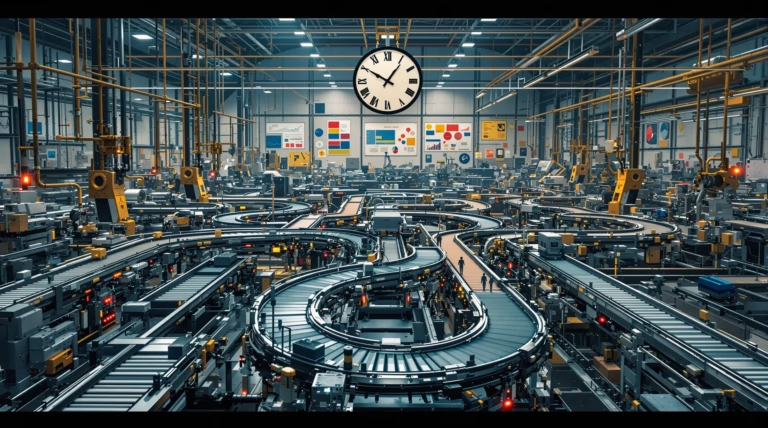
Lean Manufacturing: Principles and Benefits for Efficient Production
Discover how lean manufacturing revolutionizes production processes by maximizing value and eliminating waste. This comprehensive guide explores the principles, benefits, and real-world applications of this transformative methodology that continues to shape modern manufacturing practices.
Lean manufacturing is a comprehensive production methodology that focuses on maximizing customer value while minimizing waste. At its core, this approach considers any resource expenditure that doesn’t directly create value for the end customer as wasteful and targets it for elimination. By streamlining processes and optimizing resource utilization, lean manufacturing significantly enhances efficiency, productivity, and overall operational performance.
The eight primary types of waste in lean manufacturing include:
- Defects in products
- Overproduction beyond demand
- Waiting time between processes
- Non-utilized talent and skills
- Transportation inefficiencies
- Inventory excess
- Unnecessary motion
- Extra-processing beyond requirements
The Origins of Lean Manufacturing
The roots of lean manufacturing can be traced back to post-World War II Japan, specifically to the Toyota Motor Corporation. Facing severe resource constraints and fierce competition in the automotive industry, Toyota developed a unique production system under the leadership of Taiichi Ohno and Shigeo Shingo. What would later become known as the Toyota Production System (TPS) emerged as a revolutionary approach to manufacturing that challenged traditional mass production methods popularized by Henry Ford.
Taiichi Ohno, often referred to as the father of TPS, developed many of the foundational concepts during his time as Toyota’s chief of production. Meanwhile, Shigeo Shingo, an industrial engineer and consultant, contributed significantly by developing practical methods and tools to implement these concepts. Their collaborative work introduced game-changing practices like Just-in-Time production, Jidoka (automation with human intelligence), and the Kanban system for inventory management.
Core Concepts of Lean Manufacturing
The foundation of lean manufacturing rests on several interconnected concepts that collectively enable organizations to optimize their operations. Waste reduction stands as the primary principle—identifying and eliminating activities that consume resources without adding value.
Key elements of the 5S methodology include:
- Sort – organize and eliminate unnecessary items
- Set in order – arrange tools and materials efficiently
- Shine – maintain cleanliness and order
- Standardize – establish consistent procedures
- Sustain – maintain and review standards regularly
Principles of Lean Manufacturing
Lean manufacturing is built upon five fundamental principles that guide organizations toward operational excellence. These principles create a systematic framework for identifying and eliminating waste while maximizing value creation. Originally developed as part of the Toyota Production System, these principles have evolved into a comprehensive methodology that organizations across industries can implement to streamline their operations, reduce costs, and enhance customer satisfaction.
Specifying Value and Identifying the Value Stream
The first critical step in lean manufacturing involves defining value precisely from the end customer’s perspective. This requires understanding what features, functions, and attributes customers genuinely value and are willing to pay for. Organizations must engage directly with their target audience to gain insights into both explicit and implicit needs.
Value stream mapping (VSM) is a powerful visualization tool that documents, analyzes, and improves the flow of information and materials required to deliver a product or service to the customer. By creating a detailed map of the entire production process, organizations can identify value-adding activities that should be optimized and non-value-adding activities that should be minimized or eliminated entirely.
Ensuring Flow and Allowing Customer Pull
After identifying value and mapping the value stream, the next principle focuses on creating continuous flow in the production process. Flow eliminates stoppages, bottlenecks, and batch processing that cause delays and inventory buildup. In a properly flowing system, products move seamlessly from one value-creating step to the next without interruption, significantly reducing lead times and improving overall efficiency.
- Reconfiguring workspaces for optimal flow
- Cross-training employees to maintain continuity
- Standardizing work procedures
- Ensuring smooth transitions between process steps
- Eliminating unnecessary movement and delays
The pull system represents a fundamental shift from traditional push manufacturing methods. Rather than producing goods based on forecasts and pushing them through the system regardless of actual demand, pull systems produce items only when requested by customers or downstream processes. Just-in-time manufacturing exemplifies this principle, with production triggered by actual customer orders instead of speculative inventory requirements.
| Pull System Benefits | Implementation Methods |
|---|---|
| Reduced excess inventory | Kanban systems |
| Decreased storage costs | Visual management tools |
| Lower obsolescence risk | Customer order triggers |
| Increased market responsiveness | Real-time production coordination |
Pursuing Perfection through Continuous Improvement
The fifth principle of lean manufacturing focuses on the relentless pursuit of perfection through continuous improvement (Kaizen). This approach rejects complacency and embraces the mindset that every process can always be further refined. Unlike traditional improvement models that focus on occasional breakthrough innovations, Kaizen emphasizes frequent, incremental changes that collectively yield significant results over time.
- 5S methodology implementation (Sort, Set in order, Shine, Standardize, Sustain)
- Standardized work procedures for consistency
- Visual management systems for immediate problem identification
- A3 problem-solving methodology
- Root cause analysis techniques (5 Whys and fishbone diagrams)
- Employee engagement in improvement initiatives
Benefits of Lean Manufacturing
Lean manufacturing delivers substantial benefits across various industries, extending beyond simple cost savings. By systematically eliminating waste and optimizing processes, companies experience transformative improvements in their operational performance. Organizations implementing lean principles typically achieve:
- 25-30% reductions in inventory costs
- 15-20% improvements in labor productivity
- 50% decreases in production lead times
- Significant reduction in environmental impact
- Better resource utilization
- Enhanced operational sustainability
Efficiency and Cost Reduction
Lean manufacturing enhances operational efficiency by streamlining processes and eliminating non-value-adding activities. Organizations identify and remove workflow bottlenecks, reduce unnecessary movement, and optimize workspace layouts, leading to shorter production cycles and more responsive operations.
| Cost Reduction Area | Typical Impact |
|---|---|
| Inventory holding costs | 20-30% decrease |
| Labor costs | Reduced overtime requirements |
| Quality-related costs | Significant reduction in defects and rework |
| Overall operational costs | 20-30% decrease in first year |
Improved Productivity and Quality
Lean manufacturing significantly enhances productivity by focusing resources on value-creating activities. Through standardized work, quick changeover techniques, and visual management systems, workers accomplish more in less time without increasing effort. Organizations typically experience a 15-25% increase in units produced per labor hour.
- 50-90% reduction in defect rates
- Decreased rework and scrap
- Reduced customer returns
- Enhanced customer satisfaction
- Strengthened brand reputation
- Lower total cost of poor quality
Challenges and Criticisms of Lean Manufacturing
While lean manufacturing offers numerous benefits, it also presents significant challenges and has faced substantial criticism from various stakeholders. Organizations implementing lean methodologies often encounter obstacles that can undermine the effectiveness of their initiatives if not properly addressed through strategic planning.
- Single-minded focus on efficiency potentially compromising workforce well-being
- Reduced operational flexibility in dynamic markets
- Challenges with mass customization requirements
- Complex global supply chain management
- Adaptation needs for sustainable production practices
Demand Forecasting and Flexibility
Just-in-time production systems, while efficient, create significant vulnerability to forecasting errors. These challenges become particularly pronounced in industries with volatile demand patterns or seasonal fluctuations.
| Challenge Area | Impact |
|---|---|
| Inaccurate forecasting | Risk of overproduction or stockouts |
| Product variety | Strain on standardization processes |
| Customization demands | Need for flexible manufacturing systems |
| Market volatility | Requires sophisticated planning systems |
Employee Stress and Well-being
The impact of lean manufacturing on employee well-being represents a significant area of concern. The relentless focus on eliminating waste can create high-pressure work environments with minimal recovery time.
- Increased workplace stress and burnout risk
- Physical strain from optimized but intensive processes
- Reduced social interaction opportunities
- Constant performance scrutiny
- Diminished worker autonomy
- Limited recovery time between tasks
Applications of Lean Manufacturing Beyond Production
Lean manufacturing principles have successfully transcended their original context, delivering value across diverse industries and operational environments. The methodology’s focus on efficiency, waste reduction, and continuous improvement has proven remarkably adaptable to non-manufacturing sectors.
- Healthcare optimization
- Service industry improvements
- Software development efficiency
- Administrative process streamlining
- Supply chain management
Lean in Healthcare and Services
Healthcare organizations have achieved remarkable results through lean implementation, addressing critical challenges in patient care and operational efficiency.
| Sector Application | Results |
|---|---|
| Healthcare | 74% reduction in medication errors |
| Hospital Systems | $2M annual inventory cost savings |
| Banking Services | Streamlined loan processing |
| Hospitality | Optimized room turnover times |
Lean in Software Development
Software development has embraced lean principles extensively, leading to the emergence of Lean Software Development and influencing agile methodologies like Scrum and Kanban. Development teams utilize lean thinking to eliminate common software development wastes through visual management systems and work-in-progress limitations, resulting in optimized workflow and faster feature delivery.
- Elimination of unnecessary features and excessive documentation
- Reduction of defects requiring rework
- Minimization of delays between development phases
- Improved workflow management
- Reduced context switching
- Faster and more reliable feature delivery
| Lean Tool | Application in Software Development |
|---|---|
| Value Stream Mapping | Identifies bottlenecks in delivery pipeline |
| A/B Testing | Validates feature value before full implementation |
| CI/CD Pipelines | Enables seamless code deployment with automated quality checks |
| Cross-functional Teams | Facilitates rapid response to user needs |
Industry leaders like Spotify and Netflix exemplify successful lean implementation in software development, structuring their organizations around small, cross-functional teams that prioritize working software delivery over rigid planning. The integration of continuous integration/continuous deployment (CI/CD) pipelines demonstrates lean flow in action, showcasing how waste elimination and value creation principles can enhance complex, creative processes.